


Blog by Sanwariya Packaging

Your Trusted Partner in Packaging

Learn About Our Vision for the Future And Grow with Us.

Your Trusted Partner in Pharma Packaging

Learn about our vision for the future and grow with us.

Your Trusted Partner
in Pharma Packaging

Learn about our vision for the future and grow with us.

Know More

Tag: pharma foil

Proper handling, storage, and transport of pharma foil

Pharmaceutical products distributed internationally must comply with labeling regulations across multiple countries. In many markets, medicines are required to display information in more than one language to ensure that patients and healthcare professionals clearly understand product details and usage instructions. 

As a result, pharmaceutical packaging often needs to accommodate multilingual text while maintaining readability, regulatory compliance, and accurate information presentation. Printed aluminum blister foils frequently carry important product information such as medicine names, dosage strengths, batch details, manufacturing information, and storage instructions. 

When these details must appear in multiple languages, careful layout design becomes essential. Font size, text spacing, line order, and translation accuracy must all be managed to ensure that information remains clear and compliant. 

This blog explains how pharmaceutical companies design foil text layouts for multilingual export markets and highlights the importance of font selection, regulatory text structure, and error-free translations in multilingual pharma foil printing.

Why Multilingual Packaging Is Required in Global Markets

Pharmaceutical companies exporting medicines to international markets must follow the labeling requirements established by local regulatory authorities. Many regions require medicines to display product information in multiple languages to support safe usage and patient understanding.

Multilingual packaging helps ensure that essential product information is accessible to a diverse population.

Common reasons for multilingual labeling include:

  • Regulatory requirements in multilingual regions
  • Patient safety and accessibility considerations
  • Clear communication for healthcare professionals
  • Standardized labeling across export markets

Countries or regions with multiple official languages often require bilingual or multilingual labeling to ensure that product information is understood by all users.

When blister foils contain printed product information, the layout must accommodate these language requirements without compromising readability.

Challenges of Multilingual Text on Blister Foils

Blister foils have limited printable space, especially when compared with outer cartons or patient information leaflets. This limited surface area makes multilingual layout design more complex.

Adding multiple languages to the same foil requires careful planning to ensure that each line of text remains readable and correctly aligned.

Common challenges include:

  • Limited space for multiple language blocks
  • Variations in word length between languages
  • Maintaining clear spacing between text lines
  • Preserving readability on small blister cavities
Packaging development teams must design layouts that balance space constraints with regulatory labeling requirements. Proper planning during the artwork stage helps prevent overcrowded or difficult-to-read packaging.

Font Size and Spacing Considerations

Maintaining readable text is one of the most important aspects of multilingual pharmaceutical labeling. Font sizes must be large enough to remain legible while still fitting within the available print area on the foil.

Several design considerations help maintain readability:

  • Consistent font sizes across languages
  • Adequate spacing between lines of text
  • Clear separation between language sections
  • Avoidance of overly condensed fonts
Spacing becomes particularly important when multiple languages appear on a single foil surface. If text is too closely spaced, it may become difficult to read after printing or during product handling. Packaging artwork teams therefore evaluate layout designs carefully before finalizing the print artwork.

Regulatory Line Order and Information Hierarchy

Regulatory guidelines often specify the order in which certain information must appear on pharmaceutical packaging. This includes elements such as the product name, dosage strength, manufacturing details, batch number, and expiration date.

When designing multilingual layouts, the structure of this information must remain consistent across all languages.

Typical layout considerations may include:

  • Placing critical product identification details in a prominent position
  • Maintaining the same information sequence across languages
  • Ensuring regulatory text remains clearly visible
  • Avoiding overlap between different language blocks

Maintaining a logical information hierarchy helps ensure that healthcare professionals and patients can quickly identify important product details.

Packaging designs must therefore balance regulatory structure with available print space.

Preventing Translation Errors in Packaging Artwork

Accurate translation is essential when pharmaceutical packaging is printed in multiple languages. Even small translation errors can create confusion or lead to regulatory compliance issues.

To prevent such risks, pharmaceutical companies often follow structured translation verification processes.

These processes may include:

  • Professional medical translation services
  • Review by regulatory or medical specialists
  • Cross-checking translations against approved product documentation
  • Final proofreading before artwork approval

Because blister foils are printed in large production volumes, translation accuracy must be confirmed before printing begins.

Correcting errors after production can result in material waste or packaging delays.

Printing Precision and Layout Stability

Printing multilingual text on aluminum foil requires precise alignment and consistent print quality. Small variations in print registration or layout alignment may affect text readability, especially when multiple language blocks appear close together.

Production teams monitor several factors to maintain layout accuracy:

  • Precise printing registration across foil reels
  • Stable ink density for small text characters
  • Controlled printing pressure to maintain clarity
  • Consistent alignment of repeated blister patterns

Maintaining stable printing conditions ensures that multilingual text remains clear and readable across the entire production batch.

Reliable printing processes are therefore essential for high-quality multilingual pharma foil printing.

Export Market Considerations for Multilingual Packaging

Pharmaceutical companies supplying medicines to multiple regions often manage several packaging variations to meet local language requirements.

Export teams work closely with packaging and regulatory departments to ensure that each market receives compliant packaging.

Important considerations for export packaging may include:

  • Adapting packaging artwork for region-specific language requirements
  • Ensuring translations meet local regulatory guidelines
  • Managing multiple artwork versions for different markets
  • Maintaining consistency across packaging materials

These processes help ensure that medicines distributed internationally meet both regulatory expectations and patient communication needs.

Supporting Clear Communication Across Global Markets

Multilingual pharmaceutical packaging plays an important role in ensuring that medicine information is accessible to patients and healthcare professionals around the world. Designing foil text layouts for multiple languages requires careful attention to font sizing, spacing, information hierarchy, and translation accuracy.

By following structured artwork design practices and maintaining precise printing control, pharmaceutical companies can produce packaging that remains clear, compliant, and easy to read across international markets.

Effective multilingual labeling helps reduce communication barriers and supports safe medicine use in diverse healthcare environments.

Sanwariya Packaging manufactures printed pharmaceutical aluminum foils designed to support precise text reproduction, consistent print alignment, and high-quality multilingual printing. Through advanced printing capabilities and controlled production processes, Sanwariya Packaging helps pharmaceutical companies deliver packaging solutions that maintain clarity and regulatory compliance across global export markets.

Designing foil text for multi-language markets

Pharmaceutical aluminum foil is a critical packaging material used in blister packaging to protect medicines from moisture, oxygen, light, and external contamination. While foil structures are designed to provide strong barrier performance, their protective properties must be preserved throughout the supply chain. 

Improper handling, storage, or transportation can damage the foil surface, affect sealing performance, or compromise print quality. Because of this, pharmaceutical companies follow strict procedures when storing and transporting foil reels. 

Controlled environmental conditions, careful reel handling, and systematic inspection help ensure that packaging materials remain in optimal condition before entering the packaging line. 

This blog explains recommended pharma foil storage guidelines, including temperature and humidity control, proper reel handling practices, transportation considerations, and inspection procedures for incoming materials.

Why Proper Handling of Pharma Foil Matters

Pharmaceutical foil is manufactured under controlled conditions to meet strict quality and barrier performance requirements. However, the material can still be affected by environmental exposure or physical damage during storage and transportation.

Improper foil handling may lead to several issues:

  • Dents or deformation of foil reels
  • Damage to printed surfaces
  • Contamination of the foil surface
  • Reduced sealing performance during blister packaging

Even minor physical damage can affect packaging line performance. For example, uneven reels may cause feeding problems during high-speed blister packaging operations.

Maintaining proper handling procedures helps preserve the structural integrity and print quality of the foil.

Temperature and Humidity Control for Foil

Environmental conditions play an important role in maintaining the quality of pharmaceutical packaging materials. Excessive humidity or temperature fluctuations may affect coatings, adhesives, or printing layers applied to the foil.

Warehouses storing pharmaceutical foils typically maintain controlled environmental conditions.

Important environmental controls for foil include:

  • Stable temperature conditions within recommended storage ranges
  • Relative humidity control to prevent moisture exposure
  • Avoidance of direct sunlight or heat sources
  • Protection from sudden environmental fluctuations

Maintaining stable environmental conditions helps prevent condensation or surface degradation that could affect packaging performance.

Controlled storage environments also support compliance with pharmaceutical quality management systems.

Best Practices for Reel Handling

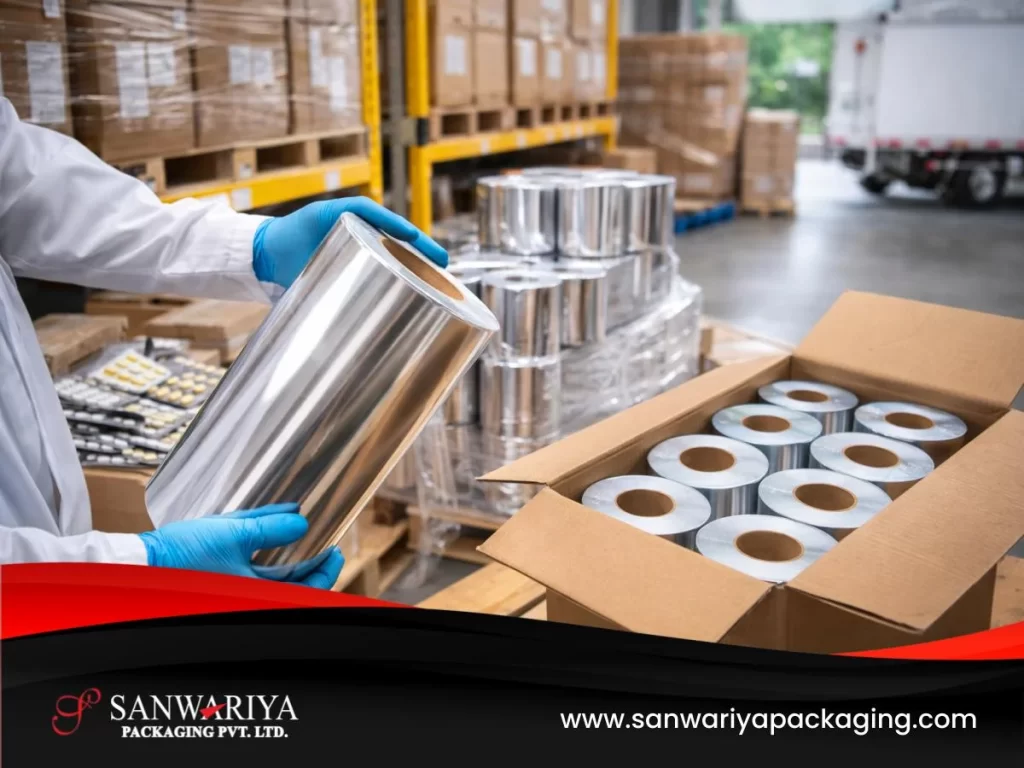
Pharmaceutical foil is usually supplied in large reels that must be handled carefully during transportation, storage, and transfer to packaging lines.

Improper handling may cause physical damage such as edge dents, crushed cores, or surface scratches.

Recommended reel handling practices include:

  • Using appropriate lifting equipment designed for reel handling
  • Avoiding rolling reels directly on warehouse floors
  • Protecting reel edges from impact damage
  • Keeping reels in their original protective packaging until use
Handling procedures should also ensure that the reels remain properly aligned to prevent deformation. Careful reel handling helps maintain smooth operation during blister packaging production.

Preventing Mechanical Damage During Storage

Mechanical damage is one of the most common causes of foil rejection during incoming material inspections.

Damage may occur when reels are stacked improperly or when heavy objects are placed on top of packaging materials.

Warehouses storing pharmaceutical foil typically follow several protective practices.

  • Storing reels vertically on stable pallets
  • Maintaining sufficient spacing between stacked materials
  • Preventing contact with sharp edges or heavy equipment
  • Ensuring stable stacking to avoid reel movement

Proper storage arrangements help protect both the foil surface and the structural integrity of the reel.

Maintaining clean and organized warehouse environments also reduces the risk of contamination.

Transportation and Logistics Considerations

Pharmaceutical foil often travels long distances before reaching the packaging facility. During transportation, packaging materials may be exposed to vibrations, environmental changes, or handling by multiple logistics providers.

To reduce these risks, foil reels are usually transported using protective packaging and secure palletization.

Key transportation considerations include:

  • Stable pallet stacking to prevent movement during transit
  • Protective wrapping to shield reels from dust and moisture
  • Shock protection to reduce vibration-related damage
  • Climate-aware transportation for sensitive materials

Export shipments may also require additional precautions, particularly when transporting materials through regions with extreme environmental conditions.

Proper logistics planning helps ensure that packaging materials arrive in usable condition.

Inspection of Foil Reels on Receipt

Quality control procedures typically require inspection of incoming packaging materials before they are released for production use.

Incoming inspection helps confirm that the materials received meet approved specifications and have not been damaged during transportation.

Common inspection checks may include:

  • Verification of reel identification and batch documentation
  • Visual inspection for dents, scratches, or surface damage
  • Confirmation of protective packaging integrity
  • Review of storage conditions during transport if required
If any issues are identified during inspection, the material may be placed on hold for further evaluation. These inspection steps help maintain quality control within pharmaceutical packaging operations.

Warehouse Inventory and Stock Rotation

Proper inventory management helps ensure that packaging materials are used within their recommended storage period.

Pharmaceutical warehouses often follow structured inventory systems that track material batches and storage durations.

Common inventory management practices include:

  • First-in, first-out (FIFO) material usage
  • Clear batch identification and labeling
  • Regular warehouse condition monitoring
  • Documentation of storage conditions and handling procedures

Following these practices ensures traceability and helps maintain packaging material performance throughout storage.

Inventory control is an important part of pharmaceutical quality management systems.

Maintaining Packaging Material Integrity Across the Supply Chain

Pharmaceutical packaging materials must maintain consistent quality from manufacturing to final use on packaging lines. Proper handling, storage, and transportation procedures help ensure that foil reels remain free from damage and environmental exposure.

Following established pharma foil storage guidelines supports reliable blister packaging performance, protects printing quality, and helps maintain regulatory compliance within pharmaceutical manufacturing environments.

Supply chain teams, warehouse managers, and quality control personnel all play an important role in protecting packaging materials throughout their lifecycle.

Sanwariya Packaging manufactures pharmaceutical aluminum foils designed for reliable barrier performance, stable printing, and compatibility with high-speed blister packaging systems. Through controlled manufacturing processes and secure packaging practices supported by its infrastructure, Sanwariya Packaging supports pharmaceutical companies in maintaining the integrity of packaging materials throughout global storage and distribution.

For further information or requirements, you can get in touch with us or directly request a quote.